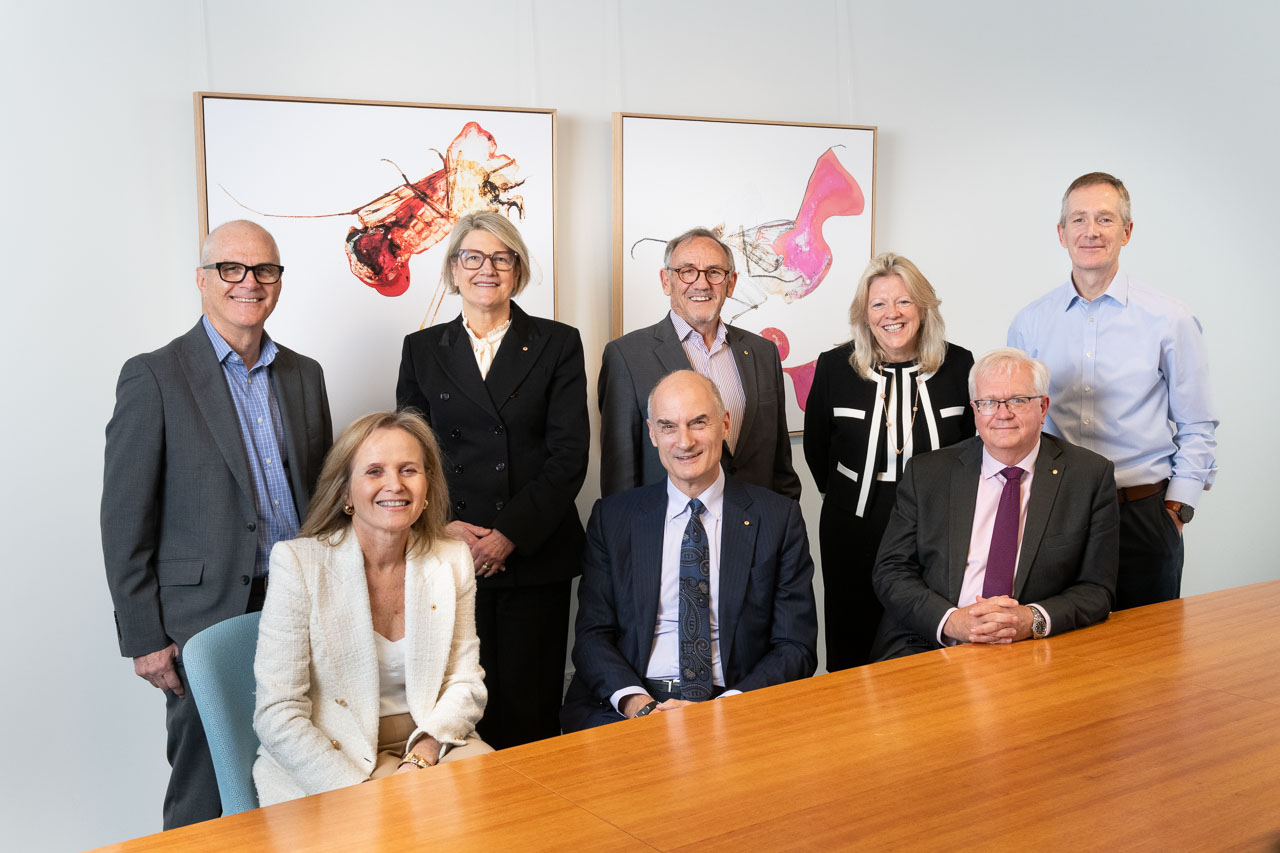
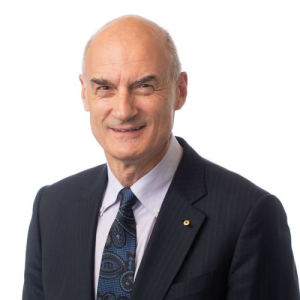
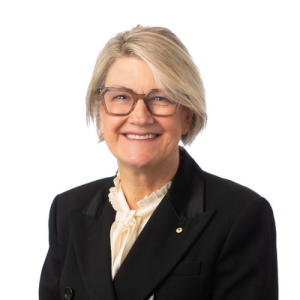
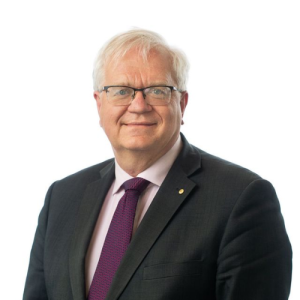
Martyn Myer is the independent chair of the Doherty Council. He is also the chair of Cogstate Ltd and the Australian Chamber Orchestra. As a trained engineer with degrees from Swinburne University, Monash University, and the Massachusetts Institute of Technology, he has a strong track record of bringing people together to execute and deliver complex projects. He brings breadth and depth of experience on the boards of commercial and not-for-profit organisations. Among his principal achievements was the creation of the Florey Neuroscience Institute, Australia’s and one of the world’s largest neuroscience institutes. He led the campaign to raise philanthropic funding for two new major research facilities at the University’s Parkville campus and the Austin Hospital. He also led the creation of one of the world’s best creative and visual arts campuses, the Faculty of Fine Arts and Music, in Melbourne’s Southbank Arts Precinct. This led to a $200+m investment over eight years, including the design and construction of a new $105m Conservatorium of Music.
Professor Sharon Lewin is an infectious diseases physician and basic scientist, who is internationally renowned for her research into all aspects of HIV disease and specifically in strategies to achieve an HIV cure. Professor Lewin is the inaugural Director of the Doherty Institute and the Cumming Global Centre for Pandemic Therapeutics, a new centre at the Doherty Institute established by a philanthropic gift of $250 million from Canadian philanthropist Geoff Cumming and $75 million from the Victorian government. She is also a Melbourne Laureate Professor of Medicine at The University of Melbourne and is the current President of the International AIDS Society (IAS) (2022 – 2024), the largest professional society representing people working in HIV medicine and has over 17,000 members. She is an Advisory Board member for the National Foundation for Australia-China Relations (NFACR) and a Board Director for Doherty Clinical Trials Ltd.
She heads a laboratory of 25 scientists and clinicians working on basic and translational research and early phase clinical trials aimed at finding a cure for HIV. Her laboratory is funded by the NHMRC, the National Institutes of Health, The Wellcome Trust, the American Foundation for AIDS Research and multiple commercial partnerships. She is also the Chief Investigator of a NHMRC Centre of Research Excellence (CRE), The Australian Partnership for Preparedness Research on Infectious Diseases Emergencies (APPRISE) that aims to bring together Australia’s leading experts in clinical, laboratory and public health research to address the key components required for a rapid and effective emergency response to infectious diseases.
Professor James McCluskey is the Assistant Vice-Chancellor at the University of Melbourne supporting the development of the Australian Institute for Infectious Disease (AIID) and the Cumming Global Centre for Pandemic Therapeutics at the Doherty Institute. He was Deputy Vice-Chancellor (Research) at the University of Melbourne, from March 2011 until July 2023, during which time he led the development of the Doherty Institute. Prior to this he was the Pro Vice-Chancellor, Research Partnerships and Chair of Microbiology and Immunology. James trained in Perth as a physician and pathologist. He spent four years at the National Institutes of Health in the USA. On returning to Australia in 1987 he worked at Monash University until 1991 before joining Flinders University and the Australian Red Cross Blood Service. James joined the University of Melbourne in 1997 and has an international reputation for his research in basic and clinical immunology and is recognised for his leadership in the field of human leukocyte antigens (HLA) and the major histocompatibility complex (MHC). He has consulted for the Australian Red Cross for more than 20 years and is Editor-in-Chief of the international immunogenetics journal, Tissue Antigens. He is on the Board of Directors of the Walter and Eliza Hall Institute, Florey Neuroscience Institutes, Bionics Institute and is Chair of the Nossal Institute Council and the Board of Nossal Institute Limited.
Professor Shelley Dolan joined the Royal Melbourne Hospital in August 2023 as Chief Executive. She previously served as the Chief Executive of the Peter MacCallum Cancer Centre.
In her previous roles, Professor Dolan has successfully led large specialist tertiary hospitals in the UK, including as Chief Executive of Kings College Hospital NHS Foundation Trust and Deputy Chief Executive of the Royal Marsden Hospital.
Professor Dolan is a highly respected clinical and research leader with an impressive track record in health care, having successfully led major organisational and cultural change in Victoria and the United Kingdom (UK).
Key capabilities include executive and non-executive leadership across national and international bodies, strategy development, delivering excellence in quality and performance, overseeing large capital schemes and innovative research projects that require engagement with a broad range of stakeholders.
Professor Jane Gunn is a distinguished academic general practitioner and inaugural Chair of Primary Care Research at The University of Melbourne where she is also Dean of the Faculty of Medicine, Dentistry and Health Sciences. Her leadership has raised the profile and rigour of primary care research in Australia.
Jane’s trailblazing research into the complex interplay between mental and physical health led to her appointment as Inaugural Visiting Professor to the Scottish School of Primary Care (2009-2012) to be part of an international team investigating multiple long-term physical health problems (multimorbidity). Her input into that work began the focus on mental-physical multimorbidity and has led to influential publications that have influenced policy.
Dr Fergus Kerr joined the Royal Melbourne Hospital as Chief Medical Officer in 2022 having been Group Director of Medical Services and Clinical Governance at Cabrini Health in Melbourne.
Fergus was appointed as an Emergency Physician and Toxicologist at Austin Health in 1997. Ten years later, in September 2007, he undertook a new challenge as Director of Emergency Medicine, and in 2011 he extended his leadership roles by taking up the Medical Directorship of the Medical and Emergency Clinical Service Unit.
More recently in a desire to develop his leadership capacity formally Fergus completed his Fellowship with the Royal Australasian College for Medical Administrators following which he took up the role as the Executive Director of Medical Services at Peninsula Health. In 2016 Fergus returned to Austin Health in an Executive position as the Chief Medical Officer. He has a strong interest in Toxicology, spending two years undertaking specialist training at the University of Pittsburgh, USA and was pivotal in establishing the Victorian Poisons Information Centre at Austin Health. He has previously been an examiner with the Australasian College for Emergency Medicine and up until January 2018 continued to practice clinically.
Elizabeth was appointed Managing Director of Telstra Health, Australia’s largest digital health company and a subsidiary of Telstra Group Limited in April 2022 and is passionate about the potential of Digital Health to transform health care delivery. Prior to this Elizabeth had a long and distinguished career in the NSW health system, with her most significant role being Secretary, NSW Health for six years from 2016 -2022. As Secretary, Elizabeth was responsible for the management of the NSW health system, the largest health system in Australia with a $30 billion budget and 124,000 FTE. In 2020/2021 Elizabeth led the NSW Health system through the COVID-19 pandemic and advised NSW government crisis cabinet on the management of COVID-19 in NSW, and the subsequent vaccination roll out. Elizabeth has chaired of the Australian Health Ministers Advisory Council (AHMAC) and its subsequent iteration of Health Chief Executives Forum. She is also a member of Chief Executive Women and is Chair of Randwick Health and Innovation Precinct (RHIP) Elizabeth was appointed a Member of the Order of Australia in the 2022 Queen’s Birthday Honours for services to healthcare. She has been awarded Honorary doctorates from Western Sydney University, the University of Sydney and the University of NSW.
Brian Schmidt is Distinguished Professor of Astronomy at the Australian National University. For his work on the accelerating universe, Brian Schmidt as leader of the High-Z SN Search team was awarded the 2011 Nobel Prize in Physics, jointly with Adam Riess and Saul Perlmutter. Schmidt has worked across many areas of Astronomy including supernovae, gamma ray Bursts, gravitational wave transients, exo-planets, and metal poor stars. Born and raised in Montana and Alaska, USA, Brian completed joint undergraduate degrees in astronomy and physics at the University of Arizona (1989), an astronomy master’s degree (1992) and PhD (1993) from Harvard University. After a postdoctoral fellowship at the Harvard-Smithsonian Center for Astrophysics, Brian Schmidt joined the staff of the Australian National University in 1995. In 2000 Schmidt was awarded the Australian Government’s inaugural Malcolm McIntosh award for achievement in the Physical Sciences, in 2006 he was jointly awarded the Shaw Prize for Astronomy, and shared the 2007 Gruber Prize for Cosmology and 2014 Breakthrough Prize in Physics with his High-Z SN Search Team colleagues. He served as the 12th Vice Chancellor and President of the Australia National University from 2016-2023.
Professor Schmidt is a Fellow of the Australian Academy of Science, The United States Academy of Science, Royal Society of London, Australian Academy of Technological Science and Engineering, Foreign Member of the Spanish Royal Academy of Sciences, and Foreign Member of the Indian Academy of Sciences. He serves on a number of boards and councils including chairing Singapore’s Academic Research Council. In 2013, he was made a Companion of the Order of Australia. Brian also runs Maipenrai Vineyard and Winery, a 2.7 acre vineyard and small winery in the Canberra District which produces Pinot Noir.