When COVID-19 swept across Victoria, not everyone experienced the pandemic equally. Many members of culturally and linguistically diverse (CALD) communities experienced a disconnect from the public health response or, at times, even harmful effects.
Doherty Institute researchers are working with local public health units such as the North-Eastern Public Health Unit (NEPHU) and community partners to co-create inclusive protocols for future outbreak responses. The goal is to work with communities most adversely impacted to design studies that improve understanding of how diseases like COVID-19 spread within homes to inform equitable public health policy and response.
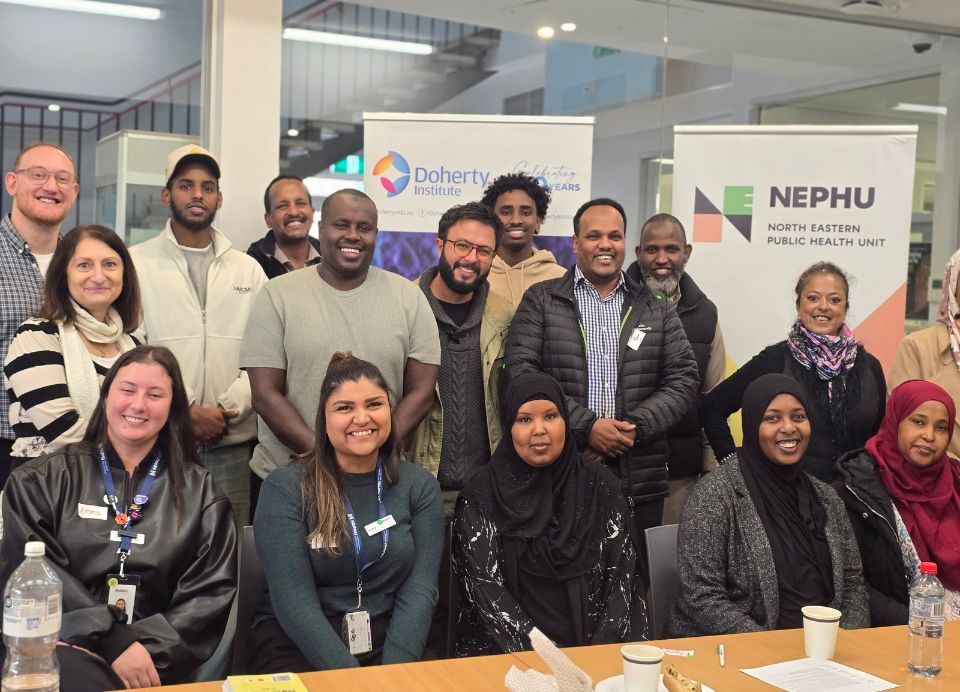
Members of the Somali Australian community in North-East Melbourne recently took part in a full-day workshop supported by two community co-facilitators and Alison Coelho, Lead Engagement Advisor for the research project and Public Health and Inclusion Advisor at Coelho Networks. Ms Coelho works with refugee, migrant and mobile populations and invariably advocates that communities must be at the centre of health research and public health initiatives.
“People are the experts of their lives. Without involving them in the design process, household studies could be perceived as intrusive rather than health positive,” said Ms Coelho.
The workshop aimed to build a shared understanding of public health needs, community values, cultural practices and priorities. Insights from the session are now informing the co-design of culturally appropriate household studies and community information sessions on immunisation.
Amal Hussein, a community co-facilitator based at Himilo Connect, an organisation working to improve various outcomes including health for the Somali community, highlighted the importance of this research program in creating a safe space for the community.
“The struggle through the pandemic affected our community deeply. Having the participants openly share their experiences and stories has helped researchers and health officials understand how to support them in the event of another pandemic,” said Ms Hussein.
Mr Hamdi Ali, community co-facilitator and Secretary of Carlton Housing Estates Residents Services (CHERS), who also works in community radio, said the research partnership is more than symbolic and has grown into something larger and more meaningful for the community.
“This work is about redistributing decision-making and involving us from the onset. It’s also about co-creating solutions and turning research into genuine protections for families, migrants and communities that can be affected by systemic neglect,” said Mr Ali.
Members of communities with large refugee and migrant populations disproportionately experience infectious diseases such as COVID-19 in Australia. Language differences, mistrust, and a lack of culturally tailored health information can limit access to and understanding of essential public health messaging. This leads to community members feeling stigmatised which may reduce or delay care-seeking.
In addition, members of these communities are over-represented in casualised essential jobs and are often not able to work from home. This heightens their risk of infectious disease and deepens inequities in health outcomes.
It is against this background that the University of Melbourne’s Dr Adrian Marcato, an Infectious Diseases Epidemiologist at the Doherty Institute, has led the development of this project, working with community and health partners at NEPHU to inform culturally appropriate health policies in outbreaks.
“Our vision is to advance Australia’s pandemic readiness by learning from community experiences. Current public health investments are not usually designed with communities and thus often do not meet their needs or have the desired impact,” Dr Marcato explained.
“Creating opportunities for meaningful, two-way discussion with communities will improve health literacy and help us better prepare for future infectious disease emergencies.”
Ms Coelho says approaching this project with reciprocity, respect and representation mitigates the usual one-way extraction of data.
“Acknowledging that communities have legitimate concerns based on historical harms and the complexities of sustained barriers experienced has supported us in stepping in a more culturally safe manner,” she added.
This research project plans to expand its reach to other community groups within Victoria.
More updates and news from the Doherty Institute

 Public Health