The first artworks created through the Lionel Gell Art in Science Initiative have been unveiled at the Doherty Institute in partnership with the University of Melbourne’s Victorian College of the Arts (VCA).
The first artworks created through the Lionel Gell Art in Science Initiative have been unveiled at the Doherty Institute in partnership with the University of Melbourne’s Victorian College of the Arts (VCA).
Honouring the creativity and generosity of the late Lionel Gell, a visionary philanthropist who championed both scientific discovery and artistic creativity, the initiative offers established VCA-trained artists a platform to explore and respond to cutting-edge biomedical science at the Doherty Institute over a nine-month residency.
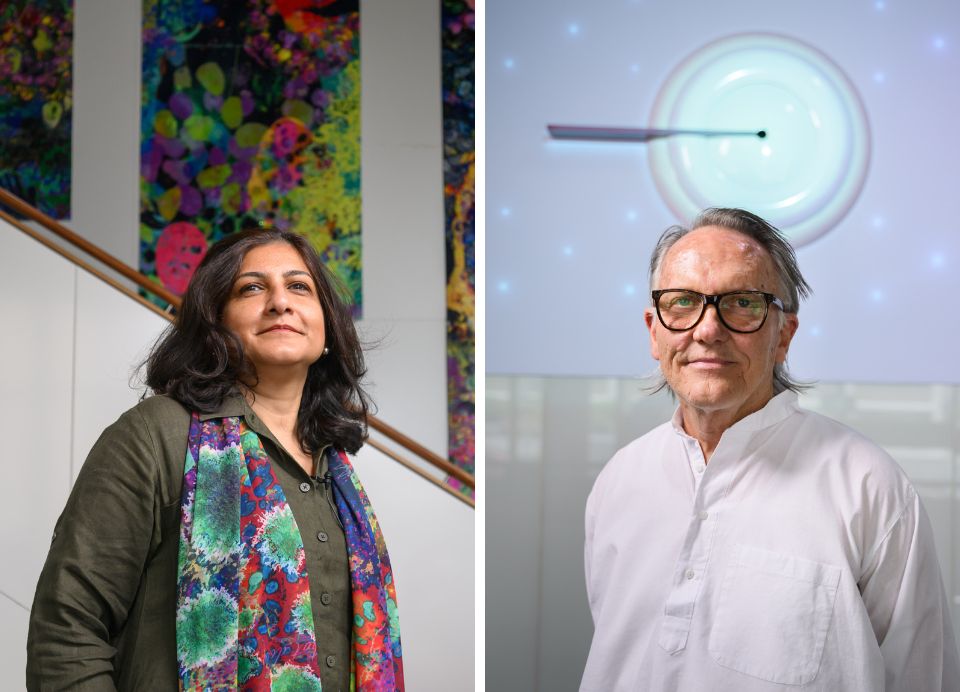
Nusra Latif Qureshi, who is acclaimed for her cross-cultural and reflective practice, and John Meade, known for his meditative sculptural abstractions, were chosen as the inaugural artists to participate in the residency.
Nusra has created three works – Luminous Landscapes of Thought I, II and III – large-scale textile hangings digitally printed on fabric, featuring glass and plastic beads. John’s Diamond Dust is a wall installation and projected animation.
The University of Melbourne’s Professor Sharon Lewin, Director of the Doherty Institute, described the finished artworks as a powerful reminder of what can happen when art and science meaningfully intersect.
“Nusra and John have transformed complex scientific ideas into pieces that invite curiosity, reflection and conversation, exactly the kind of engagement we hoped this initiative would inspire,” said Professor Lewin.
VCA Director, Professor Emma Redding, said the final works embody the conversations, experiments and cross-disciplinary exchanges that shaped them.
“The artists have created beautiful works that invite us to think and feel deeply. Lionel would have been proud to see this initiative bring the worlds of art and science together so meaningfully,”,” said Professor Redding.
David Satori, Trustee of the Lionel Gell Foundation, said the Foundation was delighted to continue its longstanding support for the VCA and the Doherty Institute.
“We are proud to have enabled the creation of a residency investigating the creative process within the context of science, and look forward to the many meaningful outcomes that will emerge,” said Mr Satori.
For painter Nusra Latif Qureshi, the residency began with a single question: how do we make visible what is not immediately visible?
This curiosity soon became the philosophical foundation of her project, shaping a sustained inquiry into the unseen structures of thinking, remembering and perceiving.
During her time at the Doherty Institute, Nusra was struck by the parallels between internal, psychological “architecture” and the microscopic landscapes revealed by scientists, intricate networks of connections, ruptures, nodes and shifting patterns.
These ideas crystallised in her three large-scale textile works, Luminous Landscapes of Thought I, II and III. Each work combines digital print on fabric with glass and plastic beading, transforming scientific concepts into shimmering, tactile surfaces.
“I am fascinated by how people think, how concepts form, dissolve, strengthen or remain unresolved,” Nusra said.
“The microscopic imaging I encountered here showed hidden structures that resonated deeply with how I build and dissolve structures in my own mind.”
Nusra emphasised that her work is not scientific illustration, but an interpretive translation of how scientific ideas settled into her imagination.
“I wanted viewers to inhabit the space between knowing and not knowing, to sense the weight of unresolved ideas and the beauty in uncertainty,” she said.
“My hope is that the work offers a contemplative space where science and subjectivity meet, where the invisible becomes quietly luminous.”
John Meade’s installation, Diamond Dust, combines wall sculpture with projected animation, offering a contemplative encounter with form, scale and the unseen architectures of matter.
Throughout 2025, John spent months speaking with immunologists, virologists and researchers across the Doherty Institute and at Bio21, as well as attending seminars and lectures spanning the breadth of contemporary biomedical science.
When it came time to begin shaping an artwork that reflected this world of cells, tissues and human pathogens, he returned to the language he knows best: abstraction.
A pivotal moment came when John sought out Assistant Professor Sergey Rubanov at the Ian Holmes Imaging Centre at Bio21, who investigates applications of diamond in quantum computing, electronics, bio-implants and energy storage.
Earlier in the year, John had noticed a colour photocopy pinned to a wall in the office of Bio21’s Director Professor Michael Parker, an X-ray crystal diffraction image of a rhinovirus produced by the Australian Synchrotron. The image lodged itself in his imagination, surfacing again as he searched for a visual entry point into the microscopic world.
Throughout the year, he also noticed similar repeated structures in viral architecture, and these diffraction images struck him with their simple, marvellous order. They became the foundation for his artwork.
“When I sat down with Sergey, it took only minutes to realise I had found what I didn’t know I was looking for,” John reflected.
Professor Rubanov shared electron microscope images of diamond film at the nanoscale on a silicon substrate, revealing extraordinary symmetry and patterning.
The result, Diamond Dust, reflects both scientific investigation and the artist’s personal aesthetic sensibility.
“My intention was to affirm the beauty of these structures and create a work that reflects my own experience of being at the Doherty Institute. I wanted the installation to echo the investigations scientists pursue each day and share that sense of discovery with everyone who moves through the space.”
Of meeting with the artists, the University of Melbourne’s Dr Sophie Paquet-Fifield, Major and Subject Coordinator (Pathology), said they discovered an unexpected synergy between them and how art can promote students’ emotional engagement and foster better learning.
“Our interpretation of the forms, textures and colours brought new perspectives to our perception of disease,” said Dr Paquet-Fifield.
“When explaining “mimicry” or “regeneration”, we found ourselves using similar language, but with fascinating different perspectives that catalysed cross-disciplinary discussions. The importance of storytelling and sketching in the learning process resonated among us, especially to grasp complex concepts more intuitively. “
Dr Lou Hubbard, a Senior Lecturer in Art (Photography) at the VCA, has been selected as the 2026 Lionel Gell Art in Science Initiative artist in residence.
Her practice spans painting, drawing, sculpture, photography and the moving image. After a long career in film and television, Lou resumed her art practice in 2000.
Dr Hubbard said she was excited to be chosen as the 2026 artist.
“This prestigious fellowship is a unique opportunity to be immersed in the activities of the Doherty Institute. The exchange of ideas with pioneering researchers will challenge my thinking, and link my curiosity and skills to make an inspired artwork,” said Dr Hubbard.
“In turn, I hope the exhibited work will inspire the Institute and the community it serves.”
Dr Hubbard has shown her work extensively around Australia, including in exhibitions at the National Gallery of Victoria, MONA FOMA Launceston and many more, as well as internationally at galleries in Istanbul, Singapore, Berlin, London and Seoul.
She has undertaken residencies in Barcelona, Paris and Antwerp and in 2015 was awarded the Art Gallery of Ballarat’s Guirguis New Art Prize and in 2020, was awarded a Doctor of Visual and Performing Arts from the University of Melbourne.
More updates and news from the Doherty Institute

 Public Health