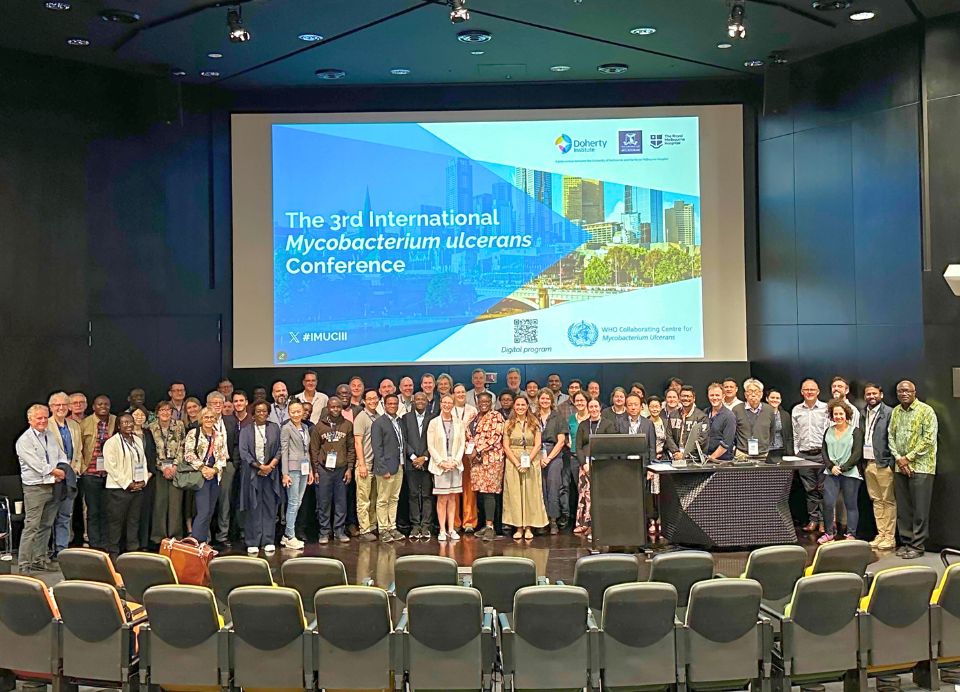
Last month, 153 experts from 21 countries convened both in person and online for the 3rd International Mycobacterium ulcerans Conference (IMUC-III). Hosted by the WHO Collaborating Centre for M. ulcerans at the Doherty Institute in Melbourne, the conference united scientists, clinicians and public health professionals with a shared mission: to share knowledge, advocate and advance the fight against Buruli ulcer.
IMUC-III provided an opportunity for global experts to reconnect and present their work on how countries address the challenges of Buruli ulcer treatment, transmission, pathogenesis and diagnosis.
“Since 1988, we’ve seen some extraordinary developments in our knowledge and understanding of Mycobacterium ulcerans.”
– University of Melbourne’s Associate Professor John Hayman, convenor of IMUC-II in 1998 and opening speaker of IMUC-III in 2024.
Buruli ulcer, a neglected tropical skin disease (NTDs) caused by Mycobacterium ulcerans, is widely reported across several countries in West and Central Africa but has seen increasing case numbers in temperate south-eastern Australia. The conference spotlighted major advances in understanding Buruli ulcer transmission, fuelled by concerted local research efforts.
“Research quality not quantity is very important.”
– Professor Françoise Portaels, from the Institute of Tropical Medicine (ITM) in Belgium, is a foremost authority with more than 50 years’ experience studying Buruli ulcer. She emphasised the importance of publishing high quality science.
Victoria’s distinctive landscape was showcased to the conference delegates who took a fieldtrip to Buruli ulcer endemic areas in picturesque Mornington Peninsula, facilitated by the Mornington Peninsula Shire Council.
“If you look back through the program, you will see that we’ve covered what many conferences would try to run in multiple streams, in multiple conferences. When you go to a Buruli ulcer conference, you see a dedicated group of people who tackle everything.”
– University of Melbourne’s Professor Tim Stinear, Director of the WHO Collaborating Centre for M. ulcerans at the Doherty Institute and convenor of IMUC-III.
“I am a little bit awed to be in the presence of so many giants, past present and future. The meeting has been phenomenal scientifically, socially, sprinkled with fantastic science, entertainment, good food and levity.”
– Dr Eugene Sun, Senior Vice President, Research and Development, TB Alliance
As the conference came to a close, the strong sense of community and possibility was apparent with recognition that, while significant progress has been made, there is still more to be done in the fight against Buruli ulcer.
With advocacy front of mind, the recording of the conference will be made publicly available in the coming weeks.
This event would not have been possible without the contributions of the conference delegates, speakers, the support of our sponsors, the Doherty Institute, The Centre for Pathogen Genomics and the Australian Society for Microbiology. and the partnership of organisations committed to eliminating Buruli ulcer globally.
Recordings of the Conference are available below. For any questions or queries, please contact imuc-iii@unimelb.edu.au
More updates and news from the Doherty Institute

 Public Health