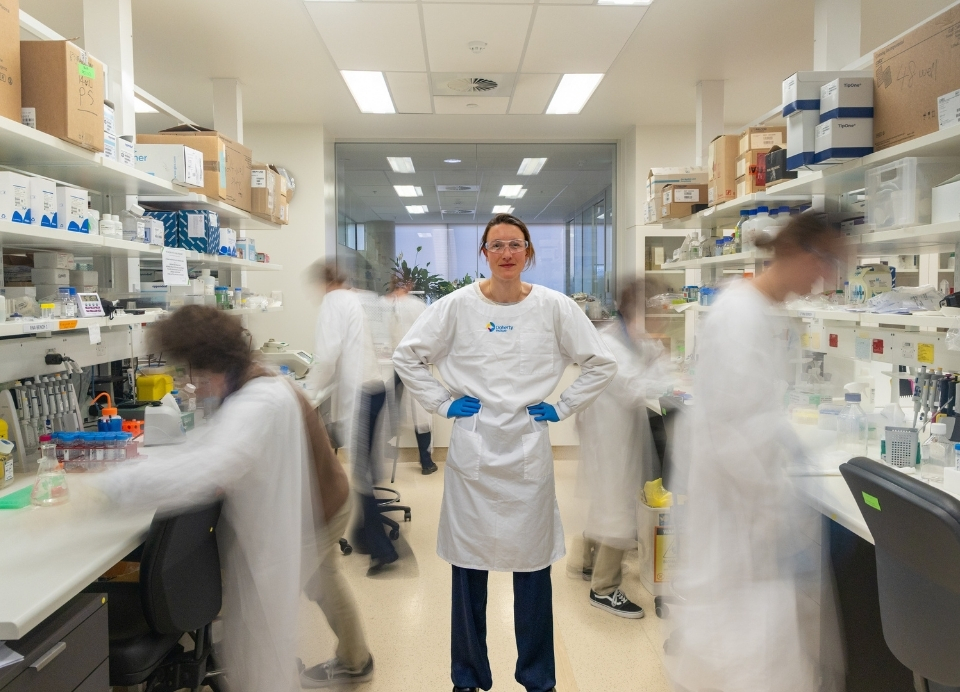
Two research projects from the Doherty Institute and its partner organisations have been named among the 59 finalists in the 2025 Australian Museum Eureka Prizes, Australia’s most prestigious science awards.
The cross-disciplinary Beating Buruli team and the University of Melbourne’s Professor Jason Trubiano, Head of the Department of Infectious Diseases at the Doherty Institute and Director of Infectious Diseases at Austin Health, have been recognised for their significant contributions to health and infectious disease research, influencing both clinical practice and public health policy.
Winners of the 2025 Eureka Prizes will be announced on September 3.
Finalist for the 2025 Eureka Prize for Emerging Leader in Science, Professor Trubiano has spearheaded significant advances in how antibiotic allergies are diagnosed and managed in hospitals.
His work has helped thousands of patients access safer, more effective treatments by developing point-of-care clinical decision tools, leading clinical trials and introducing novel immune diagnostics to distinguish true antibiotic allergies from mislabelled ones.
“One in four patients hospitalised in Australia report an antibiotic allergy. My work and research are dedicated to reducing the health impact of these reactions linked to poorer antibiotic prescribing, worse infection outcomes and the development of antimicrobial resistance, one of the world’s most pressing threats,” said Professor Trubiano.
His leadership in training programs and international networks has led to the adoption of these tools and models in hospitals across Australia and globally.
Named a finalist for the Eureka Prize for Infectious Diseases Research for the second consecutive year, the Beating Buruli team is a multidisciplinary collaboration that has cracked one of Australia's longest-running medical mysteries.
For more than 80 years, how Buruli ulcer, a neglected tropical skin disease caused by the bacterium Mycobacterium ulcerans, spreads to humans remained unknown. However, through a combination of advanced genomics, ecological surveillance and extensive fieldwork across Victoria, the team uncovered compelling evidence that mosquitoes, acting as mechanical vectors, transmit the bacteria from possums to humans.
The University of Melbourne’s Professor Tim Stinear, Director of the WHO Collaborating Centre for Mycobacterium ulcerans at the Doherty Institute and the team’s co-lead, said the findings have reshaped the national response to this emerging public health threat.
“Cases of Buruli ulcer have been rising rapidly in south-eastern Australia. Our research provides the first clear evidence of how Buruli ulcer spreads, paving the way for targeted public health action to curb its rise in Australia and prevent infections globally,” said Professor Stinear.
Launched in 2018, Beating Buruli in Victoria is a large-scale collaborative research project involving more than 22 scientists from various institutions. Partners include the Doherty Institute, the Victorian Department of Health, Agriculture Victoria, Austin Health, Barwon Health, Bio21, CSIRO, Curtin University, Millersville University (USA), the Mornington Peninsula Shire Council, the Pest and Environmental Adaptation Research Group (PEARG) at the University of Melbourne, and others.
Back row: Dr Peter Mee, Nicholas Bell, Prof Tim Stinear, Prof Paul Johnson, Jessica Porter
Front row: Dr Veronique Paris, Dr Kim Blasdell, Dr Ee Laine Tay, Dr Emma Hobbs, Dr Katherine Gibney, Dr Andrew Buultjens
Not pictured: Prof Ary Hoffmann, Dr Sara Windecker, Caroline Lavender, Maria Globan, Prof Nick Golding, Prof John Wallace, Dr Arvind Yerramilli, Dr Koen Vandelannoote, Dr Stacey Lynch-Allen, Dr Jane Oliver
More updates and news from the Doherty Institute




 Public Health