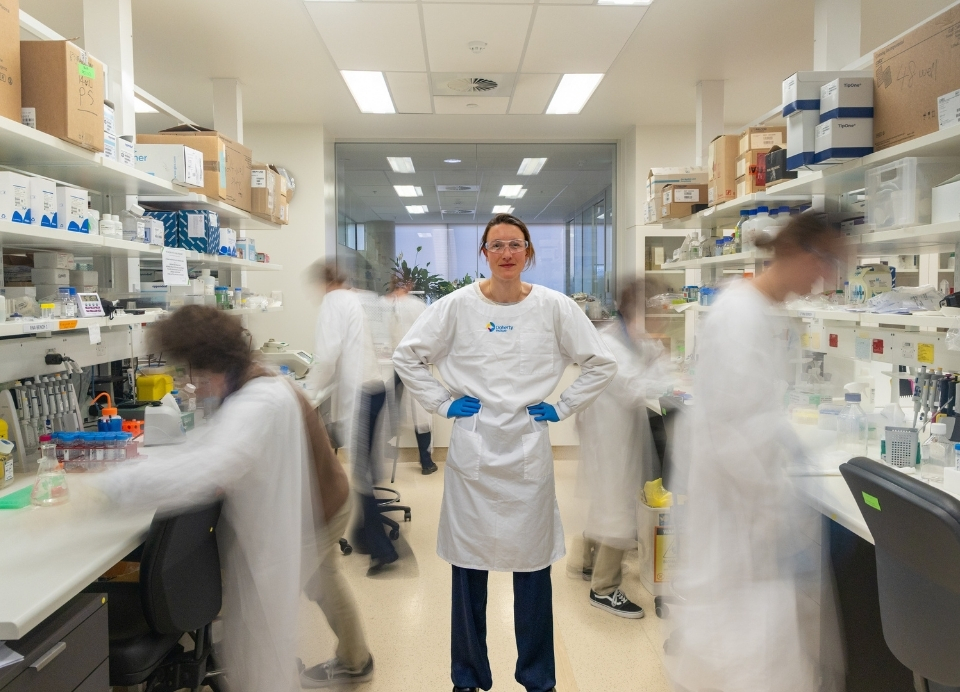
As far as we know, nanobodies occur naturally only in camel, alpacas, llamas and wobbegong sharks! But they might be a critical unlock for new antiviral therapeutics, which is the focus of The Walter and Eliza Hall Institute of Medical Research’s Professor Wai Hong Tham and Dr. Phillip Pymm’s research.
Scientists know the most powerful class of therapeutics against human diseases are antibodies, but developing new antibody treatments traditionally takes years – time you just don't have during a pandemic.
A revolutionary new approach using nanobodies might help facilitate the development of new antibody therapies, accelerating our ability to respond to future pandemic threats.
Nanobodies are extremely small antibodies. Compared to conventional antibodies, they remain more stable across a range of pH levels and temperatures – which makes them perfect candidates to support therapeutic development.
“Because of their small size, nanobodies are relatively easy to design into modular therapeutics,” Professor Tham explains, “so we're building a collection of nanobodies that can recognise pathogens with pandemic potential, creating a library we can rapidly deploy when needed.”
The project will combine cutting-edge technologies including nanobody design, structural biology, and deep mutational scanning, which is a process that predicts how viral proteins might mutate and evolve.
Using advanced imaging techniques, researchers can see exactly where nanobodies bind to viral proteins at near-atomic resolution, which is necessary information for therapeutic development.
“A challenge is that viruses constantly change and evolve. Our research allows us to map these changes and find nanobodies that are resilient in the face of new viral variants,” says Dr. Phillip Pymm. “The precision of the imaging technology enables us to develop more effective therapeutic candidates.”
The project objective is to create a rich collection of nanobodies, complete with detailed understanding of their binding mechanisms, which researchers could use to fast-track therapeutic development in the face of a pandemic threat – potentially saving lives in future pandemics.
The platform technology will combine nanobody design, structural biology insights, and mutation prediction to help researchers respond quickly in the face of new outbreaks.
“If we fully understand the characteristics of relevant nanobodies and can accurately catalogue the sequences, it will drive robust future development of viral therapeutics.”
“We want to make the sequences freely available to the global research community to help propel this development,” Professor Tham said.
Project title: Rapid and adaptable nanobody platform for generation of therapeutics against pathogens of pandemic potential
Chief Investigator: Wai-Hong Tham
Co-Investigators: Prof Colin Pouton, A/Prof Melissa Call and Dr Phillip Pymm.
Spotlight on Therapeutics: This content series profiles the projects and people behind the Cumming Global Centre for Pandemic Therapeutics innovative research.
More updates and news from the Doherty Institute



 Public Health