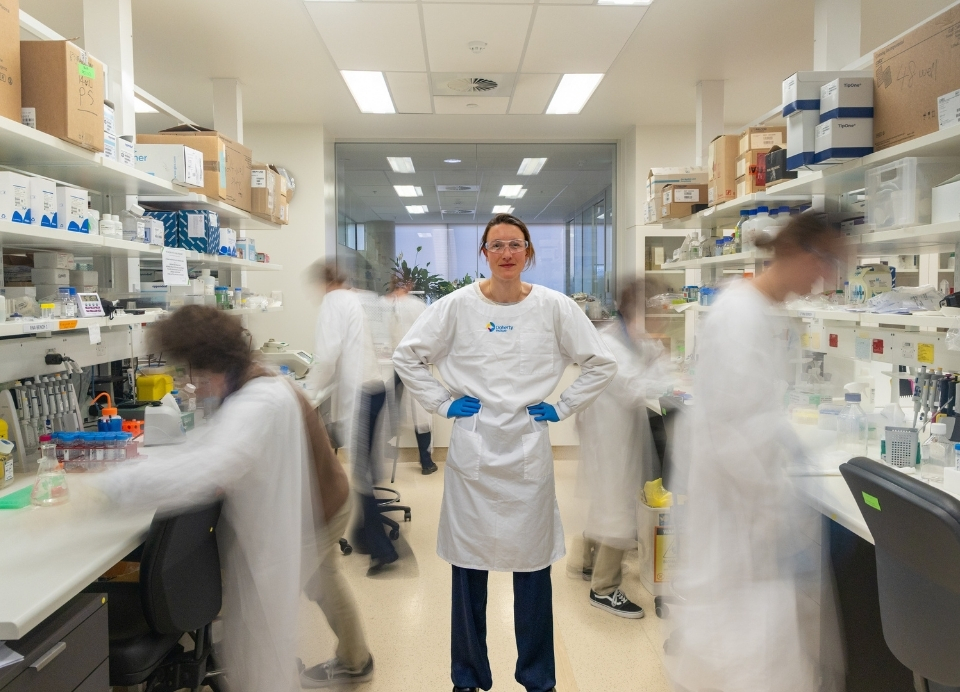
Most medical researchers will tell you that the major hurdles to developing effective therapeutics are cost, and risk. Around 90% of drugs that make it to human clinical trials fail, making the process incredibly expensive.
The Doherty Institute's Dr Daniel Utzschneider is pioneering an innovative platform that could help bridge the gap between laboratory testing and human clinical trials to help fast-track therapeutics with high potential. His team is working to produce mice with functioning human immune systems, to help researchers gain critical information about how therapeutics might behave in a human-like environment.
The aim of the platform is to enable greater understanding before the expensive and invasive human-trial stage.
“The development of new therapies requires many steps before we can test drugs in patients, which carries high risk,” says Dr Utzschneider. “One of the most important pre-clinical steps involves animal models, which have advanced biomedical science and treatments – but there's still a significant gap between animals and humans.”
While standard mice are economically efficient research subjects with many biological similarities to humans, their immune systems differ from ours in crucial ways. These differences can lead to promising treatments succeeding in mouse studies but failing in human trials – a costly and time-consuming setback.
The most compelling aspect of this research is its potential to dramatically reduce the risk of failed clinical trials.
The project involves developing specially engineered mice that lack their own immune systems, so researchers can replicate aspects of a human immune system inside the mice using human blood samples or stem cells. This enables observation of human cells in a living organism without the ethical and safety constraints of human trials, to safely fast-track promising therapeutics to clinical trial stage.
“The big advantage is that we can test multiple aspects of potential treatments in a living organism,” says Dr Utzschneider. “It means more potential therapeutics can be tested in a human-like setting without prohibitive costs – potentially opening up innovative approaches to disease response.”
By providing an extra validation step that's superior to traditional animal models, the platform will help better predict how treatments might behave in humans and enable more informed decisions about which therapeutics should progress to clinical trials.
Establishing a ready-to-go platform of these sophisticated mice is critical for pandemic preparedness and also opens up potential for research into other diseases.
“This model will allow us to study human infections like HIV,” Dr Utzschneider says. “We can monitor live how the immune system responds to infections, elevating everybody’s research and opening many avenues that are otherwise difficult to explore.”
While there are a small number of similar platforms available globally, the goal of this project is to develop the most sophisticated and practical version.
Initially funded for three years through the Cumming Global Centre, the vision is for this platform to be operational long-term. It’s an innovative enabler of medical research that could transform our ability to respond when the next pandemic threat emerges.
Project title: Development of next-generation humanized mouse model platform to fast-track therapeutic discovery
Chief Investigator: Daniel Utzschneider
Co-Investigators: Dr Roberta Mazzieri, Professor Sharon Lewin, Associate Professor Sophie Valkenburg, Professor Damien Purcell, Professor Natalio Garbi, Dr Julie McAuley, Professor Riccardo Dolcetti and Associate Professor Paul Beavis.
Spotlight on Therapeutics: This content series profiles the projects and people behind the Cumming Global Centre for Pandemic Therapeutics innovative research.
More updates and news from the Doherty Institute




 Public Health