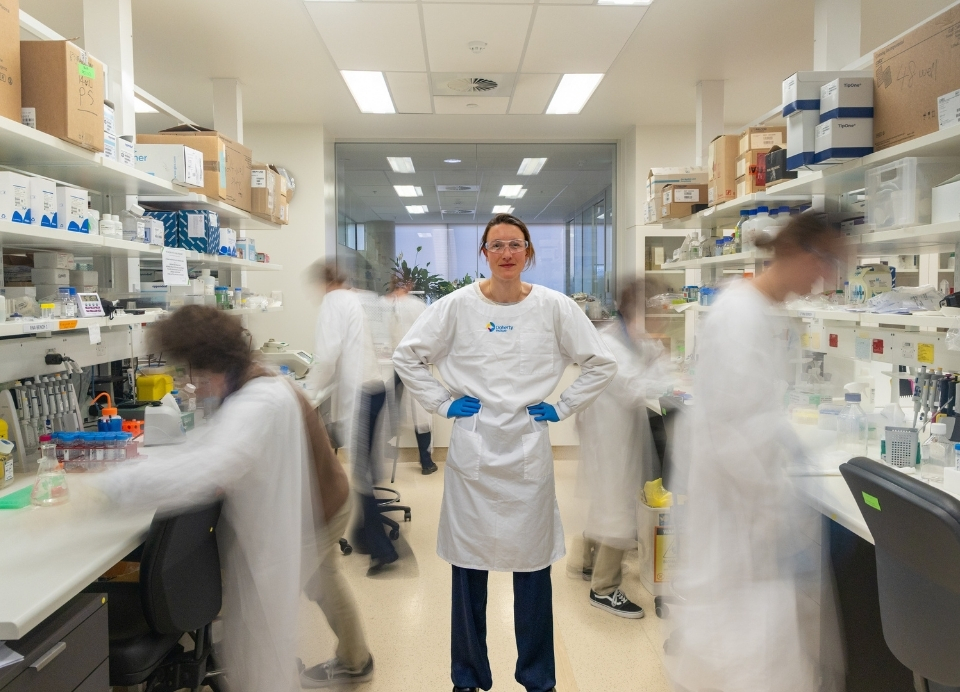
When Professor Axel Kallies and Professor Zeinab Abdullah joined forces through a global PhD program, they quickly realised their different approaches to immunology made them stronger together. Their collaboration blends rigorous science with a sense of adventure – whether investigating how comorbidities shape immunity or keeping a party from shutting down (literally) at the last second. The next chapter in their decade-long partnership will see the duo prepare for future pandemics under the Bonn-Cumming Host Directed Pandemic Therapeutics Program.
Axel: I first collaborated formally with Zeinab in 2016 as co-supervisors through a joint PhD program established between the University of Melbourne and the University of Bonn to foster global collaborations in immunology. We are both immunologists, so I was already familiar with her work, having seen her around several conferences. Zeinab is very enthusiastic about science. She is quick to adopt new concepts and has no hesitation trying new things to solve problems. I admire her for that.
We share an interest in chronic diseases, including infectious diseases, and how the body’s immune system fights them. Our immune system is made up of two arms: innate immunity, which refers to the body’s first line of defence against invading pathogens – and adaptive immunity, which provides long-lasting, specific protection against pathogens by remembering past infections and mounting stronger responses upon re-exposure. Our shared focus has traditionally been on adaptive immunity, particularly white blood cells known as T cells and B cells. T cells work to attack infected or cancerous cells, while B cells produce antibodies to target and neutralise pathogens.
Both Zeinab and I are curious about the role comorbidities play in patient outcomes when it comes to infectious diseases. This is an area that is often overlooked in the field of immunology. We bring complementary expertise in comorbidities – she has deep understanding of liver disease, whereas my lab has spent many years exploring how obesity impacts immunity. Beyond the lab, Zeinab is livelier and more outgoing than me. But we balance out each other’s strengths.
We’re shifting our joint focus under the Bonn-Cumming Host-Directed Pandemic Therapeutics Research Program, the next chapter in our ongoing partnership. Instead of pure T-cell biology, we are exploring the early communication between the innate and adaptive immune systems and how it determines patient outcomes of infectious diseases. Our research will contribute to the development of a blueprint for therapeutics that trigger the body’s natural immune response into appropriate action to fight off infection, no matter the pathogen. It’s a really exciting piece of work with a lot of promise, and it’s something new for us to explore together.
Zeinab is an incredibly generous person. When I go to Bonn, everything is always perfectly organised, including a raft of social events. One of the fondest memories I have together is when we hosted a symposium for students at Postdam, a city not far from Berlin. There is a beautiful lake there. We hired a party boat one night, and took students paddle boarding during the day. It made the program special.
If you can find different personalities that work together well, it’s a real positive. She pushes me to be better.
Zeinab: My collaboration with Axel started in 2016 in the context of an international graduate school between Melbourne and Bonn Universities. Axel was exploring a lot of the same questions as me, so it made sense that we join forces.
I believe there are three traits that define a strong collaborator: generosity, fairness and support. Axel embodies all three. While we are interested in addressing the same immunological questions, we approach our research differently.
We come from very different scientific backgrounds. My lab is investigating the impact of chronic inflammation in the liver on the function of T cells. Axel´s lab has a long-standing expertise on mechanisms driving T cell dysfunction and altered development during chronic infections. Axel works at the molecular and cellular level, while I investigate impact on the organ or the organism. We get more complete answers when we bring our expertise together.
We also come from very different personal backgrounds. I was born and raised in Iraq, where I did my Bachelor of Science. In my final year of University, Sadam Hussein’s regime attacked the Kurdish regions in northern Iraq. My family became refugees, and we fled to neighbouring Iran. I put my science career on hold for the next eight years, as I worked as a nurse, translator and social worker for Non-Government Organisations to help my people. Once the war ceased, I completed my Masters in Immunology in Iran, before eventually making my way to Germany.
Axel has big visions, and little will hold him back in pursuit of an answer. He won’t settle for the easy answer and expects rock solid evidence, but he also wants to reach an outcome efficiently. This might explain his publication record! He has no hesitation to let you know if he thinks the work lacks depth, another reason why I like working with him.
Axel is always saving my neck. One evening I was hosting colleagues in my garden at Bonn, and I forgot that my garage had an automatic shutter that closed at 11pm. I left my keys inside the house, so as the shutter started to come down, I quickly realised we would all be locked outside. Before I knew it, Axel had sprinted across the garden and slid under the garage door to keep it wedged open mere centimetres before it hit the ground. It was like a scene out of Mission Impossible.
The most important thing I’ve learned from him is to hold close detail alongside big picture thinking, without losing sight of either – that, and his taste in music.
Axel Kallies and Zeinab Abdullah are just two of the 50+ investigators who make up the Bonn-Cumming Host-Directed Pandemic Therapeutics Research Program. Established in 2024, the partnership aims to develop a blueprint for therapeutics that trigger the body’s natural immune response into appropriate action to fight off infection, no matter the pathogen. This is a revolutionary change from the more common focus on individual treatments for specific pathogens and aims to make pandemic therapeutics available in much shorter timeframes than currently possible. See here for more information.
More updates and news from the Doherty Institute



 Public Health