By The University of Melbourne’s Associate Professor Sarah Dunstan, Principal Research Fellow in Infectious Diseases and a Lead of the Global Health Cross-Cutting Discipline at the Doherty Institute
Many people think leprosy is a disease of the past, yet around 200,000 new cases are reported globally each year. The ACCELERATE project, led by University of Melbourne researchers at the Doherty Institute, combines genomics with public health efforts in Nepal to better understand how leprosy spreads and to improve strategies toward zero transmission.
Leprosy has afflicted humans since ancient times. Yet, perhaps surprisingly, this neglected tropical skin disease still impacts communities around the world today, with around 200,000 new cases reported worldwide each year. Caused by the bacterium Mycobacterium leprae, leprosy is an infectious disease that mainly affects the skin and peripheral nerves, and, if left untreated, can lead to long-term disability and visible disfigurement. Beyond the physical effects, leprosy carries substantial social stigma and mental health consequences, with people affected often facing discrimination, isolation and delayed care.
Leprosy is both treatable and largely preventable. It can be cured with standard multi‑drug therapy. Despite major global progress in reducing incidence in the late 20th century, transmission persists. Gaps in early detection, incomplete understanding of transmission, and inequitable access to health services mean that the disease persists in some settings, especially among poor and marginalised communities.
Leprosy disproportionately affects people living in poverty and underserved communities. Risk is greater where health services, education and living standards are limited. Close household contacts of a person with leprosy face increased risk, yet notably 30–60% of people diagnosed report no known contact, indicating that transmission pathways are not fully understood.
Other risk factors include areas with persistent transmission (“hotspots”), delays in diagnosis due to stigma or limited access to health services, and movement of people that can introduce strains into new communities. Nepal illustrates these dynamics: although the country declared leprosy eliminated as a public health problem in 2010, the number of people diagnosed with leprosy later rose in some districts, revealing hidden reservoirs and highlighting the need for targeted case detection.
Genomics has begun to shed light on Mycobacterium leprae, but several scientific challenges remain. Unlike many bacteria, M. leprae cannot be grown in laboratory culture, limiting large‑scale genetic studies. Advances in DNA sequencing and metagenomic techniques now allow researchers to recover whole genomes directly from clinical specimens, even when pathogen DNA is scarce.
Genomic analyses have revealed distinct strains circulating globally and have identified mutations linked to drug resistance. Other studies suggest that specific strains may influence clinical presentation or transmission patterns. Therefore, genomics can help distinguish local endemic transmission from cross-border introductions, detect and monitor the emergence of drug resistance, and guide targeted case finding, contact management and prevention measures.
The research project ACCELERATE, led by The University of Melbourne’s Associate Professor Sarah Dunstan, Principal Research Fellow at the Doherty Institute, uses whole-genome sequencing of M. leprae to understand disease epidemiology, transmission dynamics and persistence in two areas of Nepal, with the goal to improve disease control strategies.
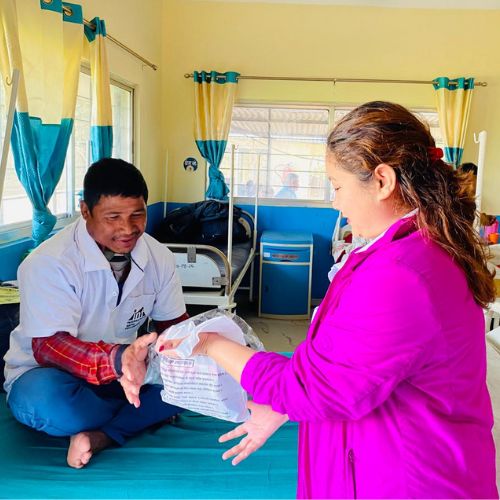
The team works with multiple partners in Nepal, including Birat Nepal Medical Trust, the Centre of Molecular Dynamics Nepal, Lalgadh Hospital and Shining Hospital, to recruit leprosy patients to the study. Community health workers and hospital staff identify people with leprosy in the community in Mahottari and Banke districts, areas with a high incidence of leprosy and a high multidimensional poverty index. Samples are flown to partner labs in Kathmandu and then to Melbourne for sequencing and analysis.
Through genomic analysis, the ACCELERATE project hopes to unravel the complexities of leprosy epidemiology and persistence, improve diagnosis, treatment and vaccine strategies.
ACCELERATE also focuses on strengthening local scientific capacity by training Nepali molecular epidemiologists and bioinformaticians. The project works closely with communities, NGOs and government stakeholders to ensure findings translate into policy and practice. Recently, ACCELERATE team member Manoj Sah, contributed to the development of the Nepal National Leprosy Strategy (2026-2030) by attending the Stakeholder Consultation Workshop.
In short, ACCELERATE blends hands on public health work with cutting edge genomics to find hidden cases, understand how leprosy spreads, guard against drug resistance, and move closer to the goal of zero transmission.
The ACCELERATE project is funded by a LEO foundation grant to the University of Melbourne and Birat Nepal Medical Trust, Kathmandu.
More updates and news from the Doherty Institute

 Public Health